


.png)
EPS vs. Recyclable Paper Liners: How Cold-Chain Packaging Is Changing
- Jul 16
- 17 min read
For decades, expanded polystyrene, commonly known as EPS, has been one of the most recognizable materials in cold-chain packaging.
Its popularity is understandable. Molded EPS coolers are lightweight, durable, resistant to moisture, and capable of protecting temperature-sensitive products from outside temperature changes. They are used to ship seafood, meat, produce, prepared foods, pharmaceuticals, vaccines, biologics, laboratory materials, and many other sensitive products.
But the cold-chain packaging industry is changing.
Businesses are being asked to reduce packaging waste, simplify recycling for customers, improve warehouse efficiency, control shipping costs, and prepare for new packaging regulations. At the same time, packaging manufacturers have introduced paper-based insulation systems that can turn an ordinary corrugated box into an effective temperature-controlled shipper.
This has created an important question for cold-chain businesses:
Should Companies Continue Using EPS Coolers or Switch to Recyclable Paper Thermal Liners?
There is no universal answer. EPS remains a practical and effective solution for many demanding shipments. Paper liners, however, can offer meaningful advantages for certain applications, especially when curbside recyclability, flat storage, customer convenience, and reduced plastic use are priorities.
The best choice depends on what is being shipped, how long it will be in transit, the required temperature range, seasonal conditions, refrigerant selection, available warehouse space, customer expectations, and the consequences of a temperature excursion.
This article examines the growing EPS-versus-paper-liner debate and explains how cold-chain businesses can evaluate both options without sacrificing product protection.
Why This Conversation Is Becoming More Important

Sustainability in cold-chain packaging is not a new topic. What has changed is the level of attention being given to the packaging after the delivery is complete.
A temperature-controlled shipment may include an outer corrugated box, an insulated container or liner, gel packs, plastic film, absorbent material, cushioning, tape, labels, and product packaging. Even a relatively small delivery can leave the customer with several components to separate, store, reuse, recycle, or discard.
That experience matters more than it once did.
Food brands, pharmaceutical distributors, meal-kit companies, laboratories, and direct-to-consumer businesses are increasingly evaluating packaging based on more than thermal performance. They are also considering:
How much space the packaging occupies before use
How easily employees can assemble it
Whether it increases dimensional shipping weight
Whether the recipient understands how to dispose of it
How the package reflects the company’s sustainability commitments
Whether the material may create future reporting or fee obligations
Whether the packaging can be right-sized for different products
Whether one system can perform consistently across multiple shipping lanes
Packaging extended producer responsibility programs are making these questions more urgent. Under EPR programs, qualifying producers may be required to report packaging data and contribute financially to recycling and waste-management systems. Oregon’s producer fee obligations began July 1, 2025, Colorado’s began in January 2026, and California’s are scheduled to begin in January 2027. Requirements differ by state and by business, but the broader direction is clear: packaging material choices are receiving greater regulatory and financial attention.
This does not mean every company should immediately eliminate EPS. It means packaging decisions increasingly need to account for the complete life cycle of the package, not only its performance during transit.
What Is Molded EPS Cold-Chain Packaging?
Expanded polystyrene is a lightweight, rigid foam made by expanding small polystyrene beads and molding them into a defined shape.
Much of its insulating ability comes from the air trapped within its closed-cell structure. This slows the transfer of heat between the package interior and the outside environment.
A typical EPS shipping system includes:
A molded EPS cooler with a fitted lid
A corrugated outer shipping box
Gel packs, ice wraps, dry ice, or another refrigerant
The temperature-sensitive payload
Cushioning, absorbent material, or product dividers when needed
America’s Packaging offers Molded EPS Shipping Coolers in a range of interior dimensions and wall thicknesses. These systems are designed to protect products such as pharmaceuticals, vaccines, seafood, produce, prepared meals, and biologics during transportation.
Why EPS became a cold-chain standard
EPS provides a combination of properties that is difficult to ignore:
Strong insulation relative to its weight
Resistance to moisture
Rigid walls that protect the payload
Consistent molded dimensions
Availability in many standard sizes
Compatibility with gel packs and dry ice
Familiar packing procedures
Competitive unit cost at sufficient volume
Because molded EPS coolers are rigid, they also create a clearly defined internal chamber. This can simplify the placement of the payload and refrigerants when a company uses a standardized pack-out.
Where EPS performs especially well
EPS may remain the better choice when:
The shipment has a long or unpredictable transit time
The product is highly sensitive to temperature excursions
The package may encounter high summer temperatures
Moisture resistance is essential
The contents are heavy or require rigid physical protection
Dry ice will be used
A validated packaging configuration already relies on EPS
The cost of product loss is much higher than the cost of packaging
The shipping lane has frequent delays or rough handling
For these applications, replacing EPS simply to use a different material could create unnecessary risk.
What Are Recyclable Paper Thermal Liners?
Paper thermal liners are insulated panels or one-piece inserts designed to fit inside corrugated shipping boxes.
Instead of using a separate molded foam cooler, the shipper places the paper insulation inside a standard box, adds the payload and refrigerants, and closes the package according to a defined pack-out.
Paper liner systems can vary significantly. Some use layered paper fibers, recycled paper, cellulose, or other fiber-based insulation. Their construction, thickness, thermal properties, moisture resistance, folding design, and recycling qualifications may differ.
America’s Packaging offers Recyclable Thermal Box Liners made from post-industrial recycled paper. The one-piece liners are designed to transform standard corrugated boxes into insulated shippers and are described as curbside recyclable and repulpable.
The company also offers Sustainable Paper Thermal Liners for businesses seeking to reduce plastic use while maintaining temperature protection. These liners are available in multiple sizes and can be incorporated into a complete cold-chain pack-out.
Why paper liners are gaining attention
The appeal of paper-based insulation goes beyond the material itself.
Paper liners can potentially help businesses:
Reduce the amount of plastic-based insulation in each shipment
Give customers a more familiar disposal experience
Store insulation flat before use
Use standard corrugated boxes
Reduce the volume occupied by bulky preassembled coolers
Adjust box and liner sizes for different products
Improve the appearance of direct-to-consumer deliveries
Support packaging sustainability goals
Prepare for greater scrutiny of packaging materials
For businesses shipping directly to households, the customer experience may be especially important. Many consumers already know how to flatten and recycle a clean corrugated box. A compatible paper insulation system may make the rest of the package easier to understand.
Local recycling rules still vary, so businesses should confirm the recycling qualifications of the exact material and provide clear disposal directions.
EPS Is Not Automatically Unsustainable—and Paper Is Not Automatically Better
Packaging decisions are often simplified into statements such as “foam is bad” or “paper is sustainable.”
Cold-chain packaging is more complicated.
A package must first protect the product. If a lower-performing package causes food spoilage, pharmaceutical loss, replacement shipments, emergency deliveries, customer refunds, or additional transportation, the environmental and financial consequences may outweigh the material savings.
EPS can also be recycled in specialized programs, although it may not be accepted in many ordinary curbside collection systems. America’s Packaging’s guide to Recycling Temperature-Controlled Packaging notes that EPS may require drop-off locations or specialized recycling facilities, while paperboard and corrugated cardboard are more commonly accepted.
Paper insulation also has limitations. Depending on its construction, it may require more thickness, a different quantity of refrigerant, moisture protection, or a carefully modified pack-out to deliver the same duration of temperature control as an existing EPS system.
The responsible question is therefore not:
Which material sounds more sustainable?
It is:
Which complete packaging system protects the product with the least reasonable amount of material, energy, weight, waste, and product-loss risk?
EPS vs. Recyclable Paper Liners: A Direct Comparison
Consideration | Molded EPS Coolers | Recyclable Paper Liners |
Thermal insulation | Strong and widely used for demanding shipments | Can provide reliable protection when properly sized and tested |
Structural protection | Rigid molded walls protect the payload | Depends partly on the strength of the corrugated outer box |
Moisture resistance | Naturally resistant to water absorption | Varies by design and may require moisture planning |
Storage | Bulky and usually stored fully assembled | Often ships and stores flat |
Assembly | Simple when using a matched cooler and box | May require folding or inserting the liner |
Sizing | Limited to available molded dimensions unless customized | Can offer greater flexibility with standard box dimensions |
Customer disposal | May require reuse, trash disposal, or specialized recycling | May offer a simpler curbside recycling process |
Direct-to-consumer presentation | Functional but may create a bulky unboxing experience | Can create a cleaner, more familiar paper-based presentation |
Dry ice compatibility | Commonly used with appropriate procedures | Must be confirmed for the specific liner and design |
Long-duration performance | Well established for many demanding applications | Depends heavily on liner design, thickness, refrigerant, and testing |
Warehouse efficiency | Requires substantial storage volume | Flat storage may reduce warehouse space requirements |
Regulatory exposure | Plastic-based material may receive greater scrutiny under some programs | Fiber-based design may support packaging-reduction goals, depending on the law and material |
Best use | Demanding, high-risk, moisture-heavy, or long-duration shipments | Chilled and moderate-duration shipments where recyclability and storage efficiency matter |
This table provides a general comparison, not a substitute for testing. Two products made from the same broad material category may perform differently because of wall thickness, density, construction, box fit, refrigerant placement, and sealing method.
1. Thermal Performance
Thermal performance is the first requirement of any cold-chain package.
EPS has a long history in temperature-controlled shipping because its closed-cell structure reduces heat transfer without adding substantial weight. It is frequently used for both refrigerated and frozen products.
Paper thermal liners can also provide effective insulation, but they should not be treated as a direct one-for-one replacement without evaluation.
A successful conversion must consider:
Liner thickness
Number of insulated sides
Corrugated box construction
Interior air space
Product starting temperature
Refrigerant temperature
Refrigerant quantity
Refrigerant placement
Expected external temperatures
Shipment duration
Carrier delays
Opening and closing procedures
Product thermal mass
Even a high-performing insulation material can fail when the pack-out is poorly designed.
For example, a large box containing a small payload may have too much empty air space. The refrigerants must then cool a larger internal volume, and movement during shipment may create uneven exposure.
Right-sizing the box can sometimes improve performance more effectively than simply adding another gel pack.
2. Refrigerant Requirements
Neither EPS nor a paper liner creates cold energy. The insulation slows heat transfer, while the refrigerant absorbs heat entering the package.
Common refrigerants include:
Water-based gel packs
Temperature-specific gel packs
Ice wraps
Phase-change materials
Dry ice
Frozen product acting as thermal mass
America’s Packaging offers Gel Packs in multiple sizes for pharmaceuticals, vaccines, biologics, foods, meal kits, seafood, and other perishable products. When paired with suitable insulation, the packs can support chilled shipments for extended durations.
For standard refrigerated applications, +30°F Soft Gel Packs provide an economical option intended to maintain chilled conditions without the intense temperatures associated with dry ice.
Nordic Ice Wraps can also provide broad surface contact around the payload. Their connected-cell design can help distribute cooling across the top, sides, or bottom of a shipment.
A transition from EPS to paper may change the required quantity or position of these refrigerants. A business should not assume that the same gel-pack arrangement will produce the same temperature profile in a new insulation system.
3. Warehouse and Storage Efficiency
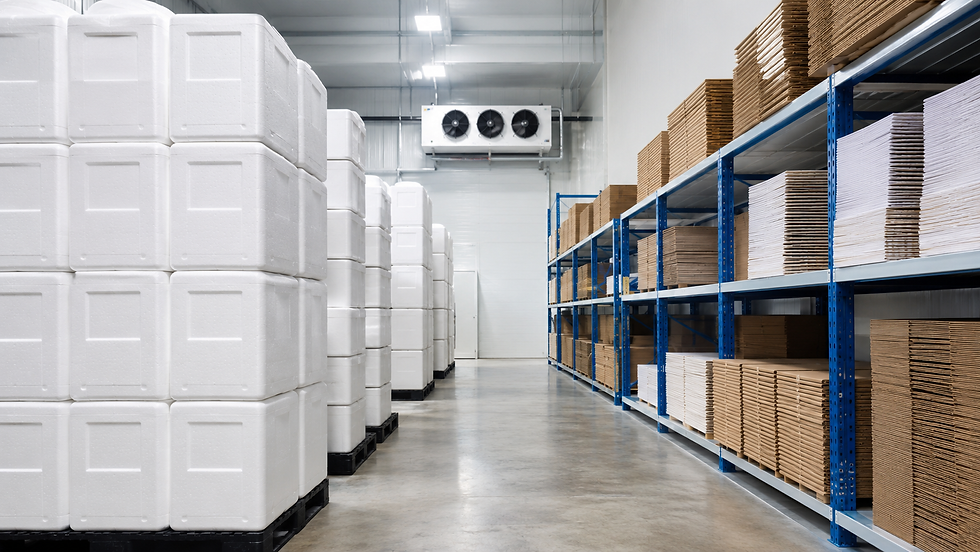
One of the most practical differences between EPS coolers and paper liners appears before the package is ever shipped.
Molded EPS containers occupy their full physical volume while stored. A stack of empty coolers can consume significant warehouse space because each unit contains a large interior air cavity.
This may create challenges for businesses with:
Limited warehouse space
High seasonal volume
Several package sizes
Frequent inventory deliveries
Small fulfillment locations
Expensive storage space
Rapidly changing product lines
Paper liners often arrive and remain flat until assembly. When paired with flat corrugated boxes, they can reduce the amount of space occupied by empty packaging inventory.
The potential benefit depends on liner thickness, case quantity, box dimensions, and order volume. Businesses should compare pallet counts and storage footprints rather than looking only at the number of units purchased.
Warehouse space has a real cost. A packaging material with a slightly higher unit price could still provide value if it reduces storage congestion, improves inventory organization, or allows more packaging units to fit on each inbound pallet.
4. Transportation and Dimensional Weight
Packaging weight matters, but exterior dimensions can matter even more.
Parcel carriers may charge based on dimensional weight when a package occupies more space than its actual weight would suggest. Because EPS coolers require rigid walls and a separate outer box, they may create a larger exterior package relative to the payload.
Paper liners can sometimes help businesses create a tighter package by using insulation fitted to a right-sized corrugated box.
However, this advantage is not guaranteed. A thick paper liner may reduce usable interior space or require a larger outer box. The only reliable approach is to compare complete package configurations.
Businesses should measure:
Exterior length, width, and height
Actual shipment weight
Dimensional weight
Number of units per pallet
Refrigerant weight
Product-to-package volume ratio
Cost by shipping zone
Damage and temperature-excursion rates
The least expensive insulation component does not always create the lowest-cost shipment.
5. Moisture and Condensation
Cold-chain packages frequently experience condensation.
Frozen gel packs can collect moisture as warmer air enters the package. Seafood, meat, produce, dairy products, and frozen foods may also release liquid during transportation.
EPS is naturally resistant to moisture and does not lose its basic form when exposed to ordinary condensation. This makes it useful for wet products and shipping environments where leaks are possible.
Paper insulation requires more careful consideration.
Businesses should evaluate:
Whether the liner has moisture-resistant layers
Whether refrigerants are likely to sweat
Whether the product could leak
Whether absorbent pads are required
Whether the box may be exposed to rain
Whether moisture affects recyclability
Whether the liner remains structurally sound during the complete transit period
A paper liner that arrives saturated may not deliver the intended customer experience, even if it maintains temperature.
For moisture-heavy applications, a company may determine that EPS remains the more dependable solution. Another business may solve the issue with sealed product packaging, absorbent pads, improved gel-pack film, or an appropriate barrier layer.
6. Customer Disposal and the Unboxing Experience

The package recipient sees cold-chain packaging differently from the shipper.
The shipper sees insulation, thermal performance, freight cost, and packing labor. The customer sees a large box filled with materials that must be handled after delivery.
With an EPS cooler, the recipient may ask:
Can I place this in my recycling bin?
Is there a local foam drop-off location?
Should I save it for reuse?
Can I break it into smaller pieces?
Does it belong in the trash?
What should I do with the gel packs?
When disposal instructions are missing, customers may guess. This can result in recyclable material being discarded or nonaccepted material contaminating a recycling bin.
Paper-based insulation may reduce some of this confusion when the liner is qualified for curbside recycling. America’s Packaging’s one-piece recyclable liners are designed to be repulpable and compatible with standard recycling streams.
Even so, brands should include clear instructions.
An effective disposal message might explain:
Remove the product and refrigerants.
Allow wet components to dry when necessary.
Separate plastic films or gel packs from paper materials.
Flatten the corrugated box.
Place qualified paper insulation in the appropriate recycling stream.
Follow local recycling rules.
Reuse or dispose of refrigerants according to their instructions.
Clear directions make the sustainability benefit easier for the customer to realize.
7. Packaging EPR and Material Reporting
Extended producer responsibility is becoming a major factor in packaging strategy.
EPR laws generally shift more responsibility for packaging waste toward the companies introducing covered packaging into a market. Depending on the program, businesses may need to register, report packaging quantities, classify materials, pay fees, or participate in a producer responsibility organization.
The exact obligations differ by state and can depend on the identity of the producer, company size, packaging type, exemptions, and sales activity. Businesses should seek legal or compliance guidance for their specific situation.
From a packaging-management perspective, the immediate lesson is simpler:
Companies need better data about the packaging they use.
Cold-chain businesses should begin tracking:
Material type
Weight of each component
Number of units shipped
Recycled content
Recyclability qualifications
Supplier documentation
State destinations
Reusable versus single-use packaging
Changes in packaging design
Gel-pack and film composition
A temperature-controlled shipper is not one material. It may include corrugated cardboard, EPS, plastic films, adhesives, paper insulation, gel refrigerant, labels, tape, and absorbent material. Reporting may require a more detailed understanding of each component.
Businesses that organize this information now may find it easier to evaluate future costs and compare material alternatives.
Which Businesses Are Best Positioned to Adopt Paper Liners?
Paper thermal liners may be especially attractive for businesses shipping:
Meal kits
Specialty foods
Chocolate and confectionery products
Dairy products
Produce
Prepared meals
Subscription food boxes
Certain refrigerated pharmaceuticals
Veterinary products
Cosmetics sensitive to heat
Laboratory supplies
Direct-to-consumer chilled products
Short- and medium-duration refrigerated shipments
These businesses often need a balance between thermal protection, presentation, storage efficiency, and easy disposal.
Paper liners may also suit companies that already use several corrugated box sizes. Rather than storing a separate molded cooler for every configuration, the business may be able to combine selected boxes with corresponding liner sizes.
Adoption should begin with testing a limited number of suitable products and routes rather than changing the entire packaging operation at once.
When EPS May Remain the Better Choice
EPS should not be eliminated simply because another material is available.
It may remain preferable for:
Frozen seafood
High-moisture food shipments
Long-duration transportation
High-value biologics
Critical pharmaceuticals
Dry-ice shipments
Products with narrow temperature limits
Rural or unpredictable delivery routes
Shipments exposed to severe summer heat
Products needing rigid impact protection
Validated systems that would be costly to replace
Situations where product loss would create major safety or financial consequences
America’s Packaging’s Molded EPS Shipping Coolers are available in multiple sizes and are intended for demanding temperature-sensitive applications.
In these cases, a better sustainability strategy might involve right-sizing the cooler, reducing unnecessary refrigerant, improving recycling instructions, using recycled-content corrugated boxes, consolidating shipments, or establishing a reuse program.
Material replacement is only one path toward improvement.
Why a One-for-One Material Swap Can Fail

Imagine that a business currently uses an EPS cooler with six frozen gel packs.
The company decides to replace the foam cooler with a paper liner. It uses the same outer dimensions, the same payload, the same six gel packs, and the same packing procedure.
The first test fails.
That does not necessarily mean the paper liner is unsuitable. The system may need to be redesigned.
Possible causes include:
Too much empty space
Insufficient liner thickness
Air gaps at the corners
Different heat transfer through the top or seams
Poor gel-pack contact
Incorrect refrigerant conditioning
A larger effective interior volume
Inadequate corrugated strength
A summer test profile that exceeds the original design
Product placement too close to a warm surface
Changing insulation materials can change the way heat enters and moves through the package.
The correct process is not to replace one component and hope for identical results. It is to redesign and test the complete system.
How to Test a New Paper-Liner Pack-Out
A structured testing program should answer three questions:
Does the package maintain the required temperature?
Does it protect the physical product?
Can the operation pack and ship it consistently?
Step 1: Define the acceptable temperature range
Do not begin with the package. Begin with the product.
Document:
Minimum acceptable temperature
Maximum acceptable temperature
Allowable excursion duration
Product starting temperature
Product dimensions and weight
Product thermal mass
Sensitivity to freezing
Sensitivity to heat
Consequences of failure
“Keep cold” is not a sufficient performance requirement.
Step 2: Establish the transportation profile
Determine:
Expected transit duration
Maximum expected delay
Shipping origin and destination
Seasonal temperatures
Time spent in vehicles or facilities
Weekend exposure
Residential porch exposure
Carrier service level
Orientation and handling risks
A package designed for a one-day regional shipment should not automatically be used for a three-day cross-country delivery.
Step 3: Build candidate configurations
Test several combinations of:
Box size
Liner thickness
Liner orientation
Gel-pack size
Gel-pack quantity
Refrigerant placement
Product placement
Void fill
Absorbent material
Closure method
The goal is to find the smallest reliable system, not the package containing the greatest possible amount of insulation and refrigerant.
Step 4: Test difficult conditions
Testing only under room-temperature conditions may create false confidence.
A business should consider summer, winter, and shoulder-season profiles when the shipment will operate throughout the year.
Step 5: Evaluate more than temperature
Record:
Interior temperature
Duration within range
Product damage
Condensation
Liner condition
Box condition
Packing time
Package weight
Exterior dimensions
Ease of opening
Disposal experience
Cost per successful delivery
Step 6: Document the final pack-out
Once the configuration is approved, create clear instructions showing:
Exact box and liner
Number and type of refrigerants
Conditioning requirements
Product orientation
Refrigerant placement
Required dividers or pads
Sealing instructions
Label placement
Seasonal variations
A high-performing design can still fail when employees pack it differently each time.
A Practical Transition Strategy
Businesses considering paper liners do not need to make an all-or-nothing decision.
A gradual transition may be more effective.
Phase 1: Audit the current package
Calculate:
Packaging cost per shipment
Refrigerant cost
Packing labor
Freight cost
Storage space
Damage rate
Temperature-excursion rate
Product-loss cost
Customer complaints
Disposal questions
Phase 2: Identify lower-risk shipping lanes
Begin with products that:
Require refrigerated rather than deep-frozen temperatures
Have short or predictable transit times
Are shipped in moderate climates
Have reliable carrier service
Are not highly sensitive to brief fluctuations
Have packaging sizes compatible with paper liners
Phase 3: Run controlled trials
Test paper and EPS systems under the same conditions. Compare the complete cost and performance of each.
Phase 4: Use a mixed packaging portfolio
Some businesses may ultimately use:
Paper liners for one- and two-day chilled shipments
EPS for long-duration or frozen shipments
Reusable containers for closed-loop business-to-business routes
Insulated mailers for small, low-risk products
Pallet shippers for bulk temperature-controlled freight
America’s Packaging offers a broad selection of Cold-Chain Packaging Products, including molded EPS containers, sustainable paper liners, recyclable thermal box liners, polyurethane coolers, insulated mailers, gel packs, ice wraps, frozen shippers, and pallet systems.
The goal should not be to force every shipment into one material. It should be to match each application with an appropriate system.
Frequently Asked Questions
Are paper thermal liners as effective as EPS?
They can be effective for many applications, but performance depends on the exact liner, wall thickness, outer box, refrigerant configuration, payload, duration, and temperature profile. A paper liner should be tested as part of a complete package before replacing an established EPS system.
Is EPS recyclable?
EPS can be recycled through some specialized collection and processing programs, but acceptance varies considerably by location. Many standard curbside programs do not accept foam packaging.
Customers should check local rules or use a designated EPS drop-off program when one is available. America’s Packaging provides more information in its Guide to Recycling Temperature-Controlled Packaging.
Can recyclable paper liners go directly into a curbside bin?
Only liners specifically designed and qualified for the applicable recycling stream should be marketed that way. The package should remain reasonably clean and dry, and local collection rules still apply.
America’s Packaging’s Recyclable Thermal Box Liners are described as curbside recyclable and repulpable.
Do paper liners require more gel packs?
Possibly, but not always.
The quantity depends on package dimensions, insulation performance, payload, transit duration, refrigerant conditioning, and ambient conditions. Testing may reveal that a right-sized paper package performs with the same amount, more, or even less refrigerant than a larger existing system.
Can paper liners be used for frozen shipping?
Some paper-based systems may support frozen applications, but the specific design must be evaluated carefully. Frozen and deep-frozen shipments create more demanding thermal requirements than standard refrigerated shipments.
Companies shipping frozen products should test the complete package under realistic conditions and confirm compatibility with the intended refrigerant.
Are EPS coolers being banned?
Regulations vary by location and by the type of EPS product. Some rules focus on food-service items rather than protective transport packaging, while EPR laws may create reporting or fee obligations without establishing an outright ban.
Businesses should review the laws applicable to their products, locations, and sales channels rather than assuming all EPS products are treated identically.
Which option costs less?
The answer depends on more than the purchase price.
A complete cost comparison should include:
Insulation
Corrugated boxes
Refrigerants
Packing labor
Warehouse space
Inbound freight
Parcel freight
Damage
Product loss
Returns
Customer service
EPR-related costs
Waste collection
Reuse or return logistics
The lowest-priced container may not create the lowest total cost per successful shipment.
The Future Is Application-Specific Cold-Chain Packaging
Recyclable paper liners are not likely to make molded EPS disappear from cold-chain shipping.
Instead, they are giving businesses another serious option.
EPS will continue to provide value where strong insulation, moisture resistance, rigid protection, and established performance are essential. Paper liners will continue gaining attention where curbside recyclability, flat storage, reduced plastic use, flexible sizing, and a simpler customer disposal experience offer greater value.
The most important industry change is not the replacement of one material by another.
It is the movement away from choosing packaging based on habit.
Cold-chain businesses increasingly need to evaluate the complete system:
Product requirements
Shipping duration
Seasonal temperatures
Refrigerant selection
Package size
Warehouse space
Transportation costs
Customer expectations
Recycling access
Regulatory obligations
Risk of product loss
A well-designed cold-chain package protects the product first. It then uses material, storage space, refrigerant, labor, and transportation as efficiently as possible.
America’s Packaging helps businesses compare Molded EPS Shipping Coolers, Sustainable Paper Liners, Recyclable Thermal Box Liners, Gel Packs, and other cold-chain packaging options based on the requirements of the actual shipment.
Contact America’s Packaging for a custom quote and discuss your product dimensions, required temperature range, expected transit time, current packaging, and sustainability goals. The company’s quote process is designed to provide a solution tailored to the customer’s cold-chain shipping needs.


Comments