


Cold Chain Packaging in 2026: Why Passive Systems, Sustainable Liners, and Right-Sized Shippers Are Winning on Cost and Compliance
If you ship temperature-sensitive products in 2026, you are probably feeling pressure from every direction at once.

Freight costs keep climbing. Sustainability reporting and packaging rules are getting harder to ignore. Customers expect clean disposal experiences. And every temperature excursion risks product loss, replacements, and compliance headaches.
Against that backdrop, something important is happening in cold-chain packaging:
High-performance passive systems—paired with sustainable liners and right-sized shippers—are winning on total cost and compliance for a growing share of lanes.
That does not mean active containers disappear. Powered systems still matter for certain high-value, long-haul, or ultra-tight-control routes. But industry analyses continue to show passive packaging dominating volume because it is simpler to deploy, easier to scale, and typically less expensive per shipment.
At America's Packaging—a certified SDVOSB based in Chicopee, Massachusetts, founded by John K. Crotty—we see the same shift every week. Packaging With Pride means matching the shipper to the lane: practical, expert, clear, and service-first—not a one-size-fits-all big-box cooler.
This guide explains what is changing in 2026, why passive systems are gaining ground, how sustainable liners and right-sizing lower landed cost, and how to build a pack-out that protects vaccines, frozen goods, pharmaceuticals, and last-mile food shipments.
What “Winning” Means in Cold Chain Packaging Right Now
Winning is no longer “buy the thickest cooler and add more gel packs.”
In 2026, winning means optimizing landed cost per successful delivery. That includes:
Packaging materials and refrigerants
Packing labor and training
Dimensional weight and freight cube
Warehouse storage footprint
Excursion risk and product-loss cost
Returns, waste handling, and sustainability reporting
Documentation needed for audits and customer qualification
Industry direction is clear: buyers are comparing active versus passive more carefully, then narrowing passive options with greater precision. For many refrigerated and frozen lanes, passive temperature-controlled packaging remains the workhorse because it does not rely on external power during transit and can be validated for specific routes.
Market research also points to continued growth in passive systems driven by biologics, direct-to-patient pharmacy, and parcel-based cold-chain fulfillment in food. Sustainability requirements are reshaping material choices toward recyclable components, reusable assets where reverse logistics work, and fiber-based insulation where performance allows.
America's Packaging helps you navigate those trade-offs with a full catalog of cold-chain packaging products—from gel packs and ice wraps to curbside paper liners, frozen vaccine shippers, and pallet shippers.
Why Passive Systems Are Beating Expensive Active Containers on Many Lanes
Active containers use powered heating or cooling. They can deliver excellent control on complex global routes. They also come with rental fees, powering, handling, returns, and reverse-logistics overhead.
Passive systems maintain temperature with insulation plus refrigerants—gel packs, ice wraps, phase-change materials, or dry ice—inside a qualified shipper. No charging. No diagnostics. No container recovery loop (unless you intentionally choose a reusable program).
Industry comparisons commonly place passive solutions in a substantially lower per-shipment cost range than active rentals for routine or regional distribution. Active remains the right tool when product value, lane risk, or duration justify the complexity. Many biopharma and specialty food programs now run a hybrid model:
Active for high-risk, long-haul, or ultra-high-value lanes
Passive for regional, last-mile, and high-volume parcel lanes
That hybrid approach is where America's Packaging focuses: build a passive pack-out that is qualified for your duration, temperature band, and payload—so you only pay for active complexity when you truly need it.
Passive building blocks that matter in 2026
A modern passive pack-out is a system, not a single SKU:
Insulation — molded EPS coolers, polyurethane cooler boxes, polyurethane one-piece liners, foil bubble liners, recyclable thermal box liners, sustainable paper liners, sustainable cotton shippers
Refrigerants — gel packs, soft gel packs, ice wraps
Outer format — corrugated carton, insulated mailers, expanding insulated mailers, thermal pouches, thermal bags, or pallet shippers
Process — conditioning, pack-out diagram, seasonal variants, and monitoring when required
When those pieces are right-sized together, passive packaging often delivers the best balance of cost, compliance documentation, and operational simplicity.
Sustainability Is No Longer Optional—And Liners Are Leading the Shift
Sustainability used to be a brand story. In 2026, it is a procurement and compliance requirement.

Regulatory pressure is rising in multiple markets. In the European Union, the Packaging and Packaging Waste Regulation (PPWR) is pushing packaging toward recyclability and clearer end-of-life design. In the U.S., state extended producer responsibility (EPR) programs and foam restrictions are increasing attention on material choice, reporting, and disposal claims. Customer expectations—especially in meal kits, D2C food, and specialty pharmacy—are moving in the same direction.
That is why fiber-based and recyclable liner systems are gaining share for chilled and moderate-duration shipments:
[Curbside recyclable paper liners](https://www.americaspkg.com/curbside-paper-liners) — designed for familiar household recycling streams where accepted
[Sustainable paper liners](https://www.americaspkg.com/sustainable-paper-liners) — paper-based thermal protection that reduces reliance on plastic foam in the right applications
[Recyclable thermal box liners](https://www.americaspkg.com/recyclable-thermal-box-liners) — turn a standard corrugated box into an insulated shipper and store flat before use
[Sustainable cotton shippers](https://www.americaspkg.com/sustainable-cotton-shippers) — natural-fiber options for brands prioritizing material story and performance balance
Paper and fiber liners are not automatic replacements for every EPS or polyurethane cooler. Long-duration frozen lanes, high-moisture seafood, and dry-ice-intensive routes may still favor rigid foam systems such as molded EPS coolers or polyurethane cooler boxes. The winning strategy is a portfolio: sustainable liners where they protect the product and simplify disposal; proven foam or PU systems where risk demands them.
For a deeper material comparison, see our related post: EPS vs. Recyclable Paper Liners: How Cold-Chain Packaging Is Changing.
Practical sustainability wins you can capture this quarter
Flat storage — liners and mailers often store flatter than bulky molded coolers, freeing warehouse cube.
Clearer unboxing — recipients understand paper recycling better than foam drop-off rules in many markets.
Right-sized SKUs — fewer oversized coolers mean less refrigerant, lower DIM weight, and less waste.
Documented claims — match disposal language to the exact liner qualification and local rules; do not overclaim.
America's Packaging can help you compare liner options against your current pack-outs so sustainability goals do not create excursion risk.
Right-Sized Shippers: The Quiet Cost Lever Most Teams Underuse
Oversizing is one of the most expensive habits in cold chain.
A shipper that is too large creates empty air volume that refrigerants must overcome. It also increases exterior dimensions—raising dimensional weight charges—and encourages teams to “solve” weak pack-outs by adding more gel packs.
Right-sizing works the other way:
Match interior volume to payload thermal mass
Select insulation thickness for the true lane duration
Place refrigerants for contact and airflow, not guesswork
Use the smallest outer format that still passes summer and delay profiles
Formats to consider by use case
Use case | Right-sized direction | America's Packaging options
Use case: Small last-mile pharma / samples — Right-sized direction: Mailers and pouches — America's Packaging options: Insulated mailers, expanding insulated mailers, thermal pouches, thermal bags
Use case: Parcel chilled food / meal kits — Right-sized direction: Paper or recyclable liners in corrugated — America's Packaging options: Curbside paper liners, sustainable paper liners, recyclable thermal box liners
Use case: Demanding refrigerated / frozen — Right-sized direction: Rigid coolers + gels / ice wraps — America's Packaging options: Molded EPS, PU cooler boxes, gel packs, ice wraps
Use case: Vaccine / deep frozen — Right-sized direction: Purpose-built frozen shippers — America's Packaging options: Frozen vaccine shippers, extreme frozen shippers
Use case: Bulk B2B — Right-sized direction: Pallet-level protection — America's Packaging options: Pallet shippers
Right-sizing is also a compliance advantage. Auditors and customers increasingly want route-specific pack-outs—not a generic cooler used for every SKU. Documented configurations are easier to train, easier to qualify, and easier to defend when a lane changes.
Vaccine, Frozen, and ULT Needs: Where Passive Still Earns Its Place
Vaccines, biologics, and frozen therapeutics raise the stakes. Temperature bands can be refrigerated (commonly 2–8°C), frozen (around −20°C), or ultra-low for specialized products. A packaging miss is not just a spoiled carton—it can mean patient impact and regulatory exposure.
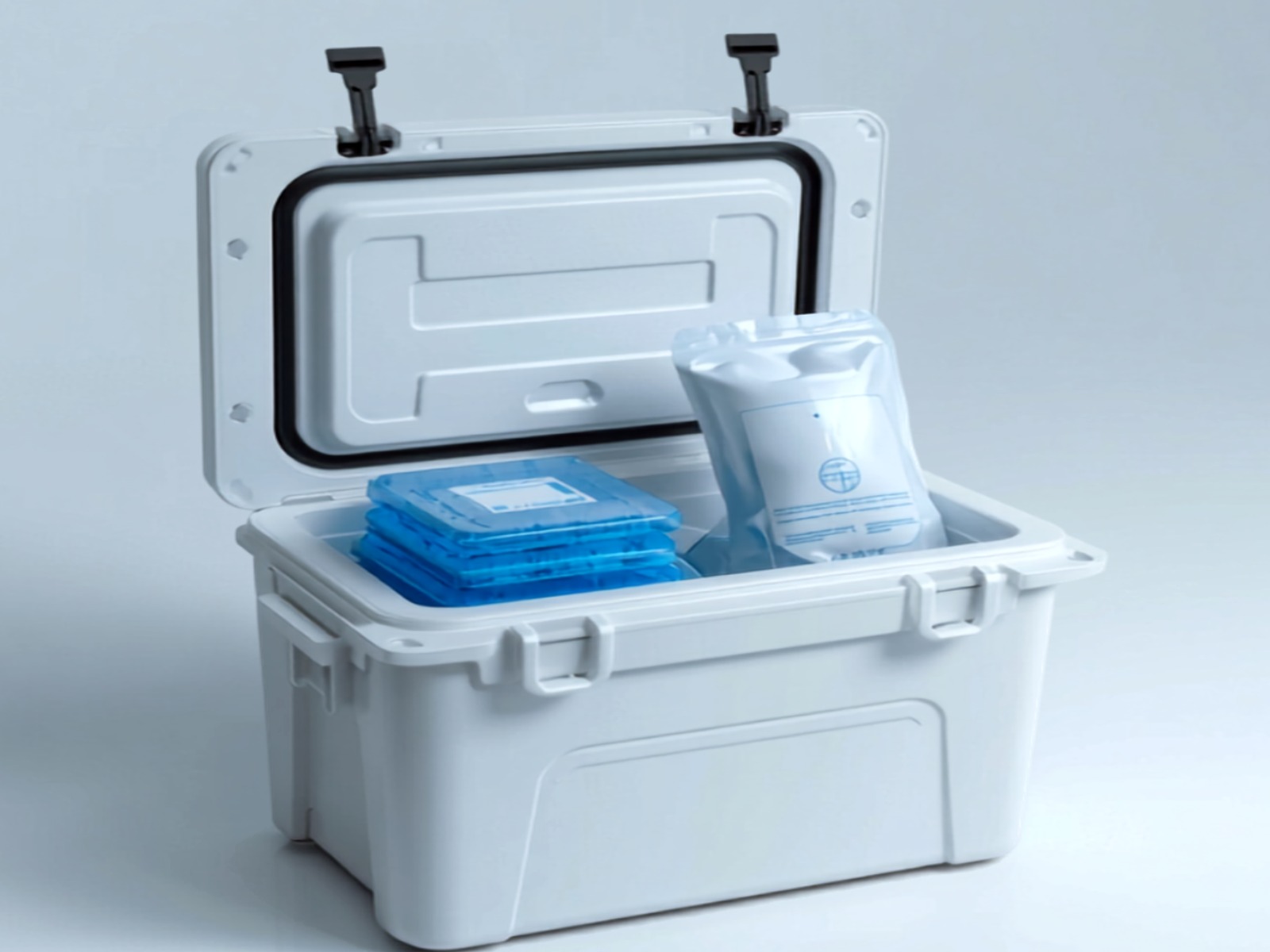
Passive systems remain widely used for vaccine and frozen distribution when the shipper, refrigerant strategy, and monitoring plan are qualified for the lane. Purpose-built options from America's Packaging include:
[Frozen vaccine shippers](https://www.americaspkg.com/frozen-vaccine-shippers) — configured for vaccine cold-chain profiles
[Extreme frozen shippers](https://www.americaspkg.com/extreme-frozen-shippers) — for deeper frozen requirements and harsher ambient exposure
[Polyurethane cooler boxes](https://www.americaspkg.com/polyurethane-cooler-boxes) and [polyurethane one-piece liners](https://www.americaspkg.com/polyurethane-one-piece-liners) — higher insulation performance when payload space and duration demand it
[Foil bubble liners](https://www.americaspkg.com/foil-bubble-liners) — reflective radiant barriers as part of multi-layer pack-outs
For pharmaceutical distribution best practices beyond packaging selection, see: Packaging and Transporting Pharmaceuticals: A Comprehensive Guide.
A practical frozen / vaccine checklist
Define the product temperature band and allowable excursion rules before choosing packaging.
Map worst-case transit time, including weekend delays and porch time for last-mile.
Confirm refrigerant conditioning (frozen vs refrigerated gels; dry ice procedures where used).
Validate the full pack-out—not just the cooler SKU.
Train packing staff with a photo-based pack-out sheet.
Add temperature indicators or data loggers when the customer or quality system requires them.
America's Packaging supports these programs with service-first guidance—not a catalog-only transaction.
Gel Packs, Soft Gels, and Ice Wraps: The Refrigerant Layer That Makes Passive Work
Insulation slows heat transfer. Refrigerants absorb heat. If the refrigerant layer is wrong, even a premium shipper fails.
In 2026, teams are moving from “throw in whatever gels we have” to specified refrigerants:
[Gel packs](https://www.americaspkg.com/gel-packs) — versatile workhorses for pharmaceuticals, foods, seafood, and meal kits
[Soft gel packs](https://www.americaspkg.com/soft-gel-packs) — flexible contact around irregular payloads; useful for chilled profiles
[Ice wraps](https://www.americaspkg.com/ice-wraps) — broad surface coverage that can wrap tops, sides, or bottoms for more even cooling
Refrigerant tips that protect both product and budget
Condition gels to the temperature your pack-out validation used—not an improvised freezer setting.
Avoid direct freeze-burn contact when product is freeze-sensitive; use barriers or soft gels as designed.
Recalculate refrigerant quantity when you change insulation type (for example, EPS to paper liner).
Weigh refrigerant cost and weight against freight—extra gels are not free if they push you into a higher billable weight.
When America's Packaging designs a custom quote, refrigerant selection is part of the system—alongside liner or cooler choice—because that is how you win on cost and compliance together.
Pallet Shippers and Last-Mile Pharma / Food: Two Ends of the Same Strategy
Cold chain is not only parcel boxes.
Pallet shippers for bulk and hub moves
Pallet shippers protect larger payloads between manufacturing, distribution, and regional hubs. They reduce per-unit packaging complexity and can support reusable or lease-oriented programs where reverse logistics are dense enough to justify the loop.
Industry interest in reusable leasing continues to grow when return networks are reliable. Where returns are weak or destinations are too dispersed, high-performance single-use or limited-reuse passive systems remain practical.
Last-mile pharma and food
Last-mile is where passive packaging often shines: courier networks, residential delivery, specialty pharmacy, meal kits, and perishable e-commerce. Speed varies. Porch exposure varies. The packaging must be simple for packers and understandable for recipients.
That is why mailers, thermal pouches, and paper liners are so important in 2026 last-mile design:
Insulated mailers and expanding insulated mailers for smaller payloads
Thermal pouches and thermal bags for flexible formats
Paper and recyclable liners for carton-based meal and grocery programs
One company value that matters here: service-first packaging advice. America's Packaging helps you choose for the lane you actually run—not a warehouse full of oversized coolers “just in case.” Learn more about how we work on our company values page and browse the latest insights on the blog.
How to Build a 2026-Ready Passive Pack-Out (Actionable Takeaways)
Use this sequence whether you are refreshing one SKU or redesigning an entire cold-chain portfolio:
1. Start with product risk, not packaging preference
Document temperature band, freeze sensitivity, duration, and cost of failure.
2. Map the lane honestly
Include carrier delays, seasonal heat, and last-mile exposure. Design for the worst credible day—not the average day.
3. Choose insulation for the application
Paper/recyclable liners for many chilled parcel lanes. EPS, PU, cotton shippers, or specialty frozen shippers when duration and risk demand them.
4. Right-size before you “add more cold”
Reduce void space first. Then specify gel packs, soft gel packs, or ice wraps.
5. Validate and document
Qualify the complete configuration. Create a pack-out sheet. Train the team. Control seasonal variants.
6. Align sustainability claims with reality
Use curbside paper liners and recyclable thermal box liners where they fit—and keep foam or PU systems where product protection requires them.
7. Review landed cost quarterly
Track packaging + freight + labor + loss. The cheapest component is rarely the cheapest successful delivery.
FAQ: Cold Chain Packaging in 2026
Are passive cold chain systems cheaper than active containers in 2026?
For many routine refrigerated and frozen lanes, yes—passive systems are typically less expensive per shipment because they avoid rental, powering, and return-handling fees common with active containers. Active systems still make sense for high-value, long-haul, or high-risk lanes. Many companies use a hybrid model: active where risk demands it, passive where volume and cost efficiency matter most.
Why are sustainable and recyclable paper liners growing in cold chain packaging?
Sustainability mandates, EPR-style reporting, customer disposal expectations, and warehouse efficiency are pushing buyers toward fiber-based and recyclable liner systems for suitable chilled shipments. Paper liners can store flatter than bulky foam coolers and may simplify recipient recycling where qualified. They should still be validated for duration, moisture, and temperature performance before replacing an existing foam pack-out.
What does “right-sized shipper” mean for cold chain cost and compliance?
Right-sizing means matching shipper volume, insulation, and refrigerants to the payload and lane—not defaulting to an oversized cooler. Smaller, correctly designed systems can reduce dimensional weight, refrigerant use, packing labor variability, and excursion risk. Documented right-sized pack-outs also support audits and customer qualification better than generic one-size packaging.
Can passive packaging handle vaccine and frozen shipments?
Yes—when the shipper, refrigerant strategy, and pack-out are qualified for the required temperature band and transit profile. Purpose-built frozen vaccine shippers, extreme frozen shippers, polyurethane coolers, and correctly conditioned gel packs or dry ice systems are commonly used. Ultra-sensitive or ultra-long lanes may still require active or hybrid approaches.
How do gel packs and ice wraps fit into a modern passive pack-out?
Gel packs, soft gel packs, and ice wraps provide the thermal energy that insulation alone cannot. They should be selected and conditioned for the target temperature profile, placed according to a validated pack-out, and recalculated whenever insulation or box size changes. Broad-contact ice wraps can improve surface coverage; soft gels help around irregular payloads.
When should a company use pallet shippers instead of parcel coolers?
Pallet shippers are typically better for bulk moves between facilities, hubs, or high-volume B2B destinations where per-unit parcel packaging would be inefficient. Parcel coolers, liners, and mailers remain better for dispersed last-mile deliveries. Some networks combine both: pallet protection for trunk moves and right-sized parcel systems for final delivery.
Get a Custom Quote from America's Packaging
If your team is redesigning cold-chain packaging for 2026—whether you need sustainable paper liners, frozen vaccine shippers, pallet shippers, or a complete gel-and-liner system—America's Packaging is ready to help.
We are a certified SDVOSB in Chicopee, MA, built on Packaging With Pride: practical expertise, clear recommendations, and service-first support.
[Contact America's Packaging to get a custom quote](https://www.americaspkg.com/contact) — tell us your product dimensions, temperature range, transit time, current packaging, and sustainability goals. We will help you build a passive system that wins on cost and compliance.
Explore the full catalog of cold-chain packaging products, learn about our founder, or browse more insights on the America's Packaging blog.


Comments